Italy
Portofino – The Christ, the Red Coral, and the MPA
The Portofino Marine Protected Area compresses everything the Mediterranean does well into a few kilometres of Ligurian coastline — red coral at depth, grouper the size of dogs, and a bronze Christ standing in 17 metres of green water.
The marine park the Ligurian coast built
The Portofino Marine Protected Area was established in 1999, covering the promontory and its surrounding waters. The practical effect is visible immediately: fish densities inside the boundary are measurably higher than outside it, grouper have lost their wariness of divers, and the red coral — Corallium rubrum, harvested to near-extinction across the Mediterranean — has recovered enough to be found in colonies at recreational depth.
The Portofino promontory has been occupied without interruption since Roman times — first as a fishing settlement, then as a port of call on the Ligurian coastal trade route, and eventually as a site of religious significance when Benedictine monks established the Abbey of San Fruttuoso in the 10th century. The abbey was built to house the relics of Saint Fructuosus, a 3rd-century bishop of Tarragona, and its tower was added in the 16th century as a watchtower against Saracen raids from the sea. The village that grew beneath it had no road connection to the interior — by design as much as geography — and still does not. The only way in is by water or on foot over the headland.
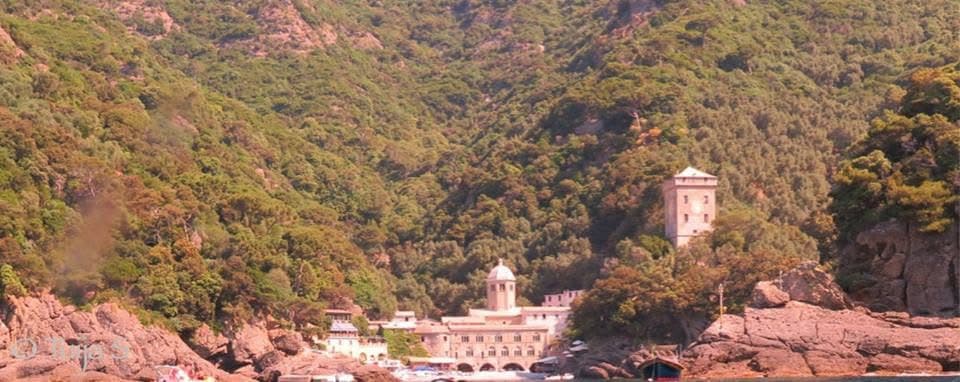 San Fruttuoso abbey seen from the water on the approach by ferry — no road reaches the village; the sea is the only way in
Il Cristo degli Abissi
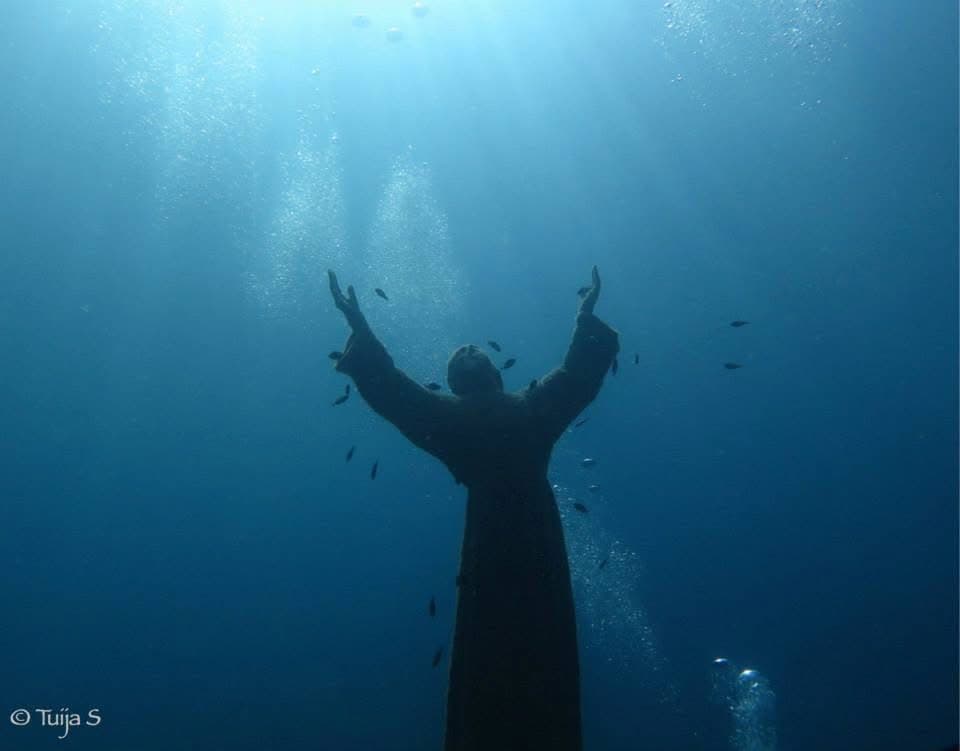
The Christ of the Abyss is a bronze statue placed at 17 metres in the bay of San Fruttuoso in 1954, arms raised toward the surface, installed by a diver named Duilio Marcante as a memorial to a fellow diver who died there. It has been encrusted continuously by marine growth since — anemones on the outstretched hands, algae in the folds of the robe, small wrasse working the creases.
The dive is not technically demanding. The statue sits on a sandy bottom in good visibility and the depth is easily managed on a single tank. What it delivers is atmosphere that depth and technicality cannot manufacture. The figure resolves out of the blue-green water at about 10 metres on the descent, arms first, and the scale — it stands roughly two and a half metres tall — doesn't register until you're beside it.
The bay at San Fruttuoso sits within the protected zone and its ecology reflects 25 years of reduced fishing pressure. European grouper — Epinephelus marginatus — are the indicator species here; heavily targeted across the wider Mediterranean, they have recovered to near-historical densities inside the MPA boundary. Specimens exceeding a metre in length are routine on the Cristo dive, and their behaviour around divers is markedly different from animals in unprotected water: unhurried, territorially confident, and inclined to hold station rather than retreat. Brown meagre, two-banded sea bream, and conger eels occupy the deeper structure around the statue's base, with octopus and scorpionfish against the rockwork at mid-depth.
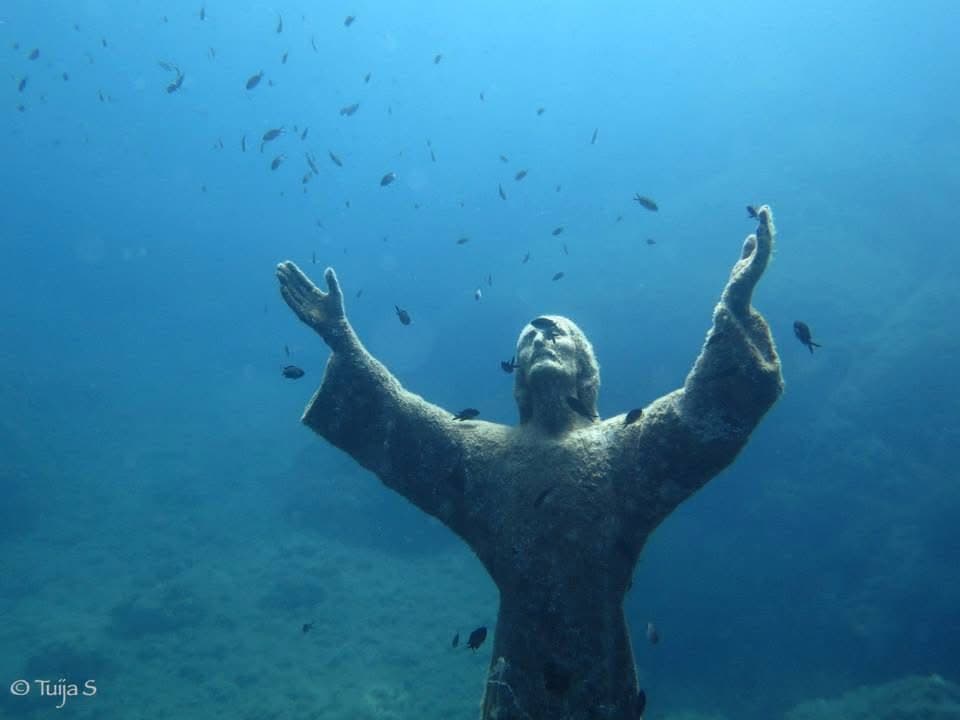 Il Cristo degli Abissi from the front — anemones on the hands, small wrasse working the folds of the robe, and a grouper stationed at the base of the plinth
Il Cristo degli Abissi silhouetted from below — diver bubbles rising past the outstretched arms toward the surface at 17 metres
The red coral walls
Corallium rubrum — Mediterranean red coral — grows in branching colonies on shaded rock faces below 15 metres, maturing at approximately 1 centimetre per year. It was harvested intensively for jewellery throughout the 20th century and was locally extinct in much of the Mediterranean by the 1990s. Inside the Portofino MPA, it has been recovering for 25 years.
The colonies on the shaded walls of Secca dell'Isola are not large — the largest reach perhaps 15 centimetres — but they are numerous, and their colour against the grey Ligurian rock is extraordinary: deep arterial red, alive enough to seem almost wrong for a cnidarian. A pair of conger eels occupies a crack directly beneath the largest colony, visible from the head in and apparently permanent.
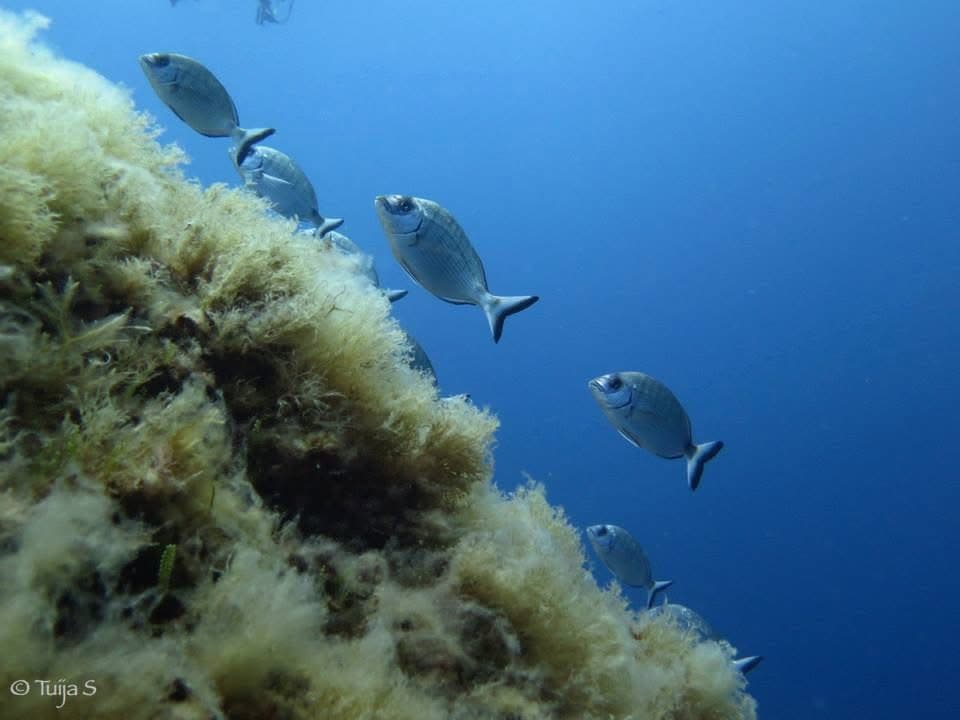 Mediterranean sea bream moving along the algae-covered wall at Secca dell'Isola — fish density noticeably higher inside the protected boundary
The Mediterranean pace
Mediterranean diving operates on a different rhythm to tropical diving. The sites are smaller, the marine life less immediately dense, the visibility more variable. What it offers in return is detail — a reef that rewards slow, attentive diving more than distance covered. A single 75-minute dive at Secca dell'Isola can produce three species of nudibranch, two octopus, one very large scorpionfish invisible against the rock until it moves, and a grouper that follows divers for sustained distances at a consistent 1.5-metre distance, apparently curious about what they're looking at.
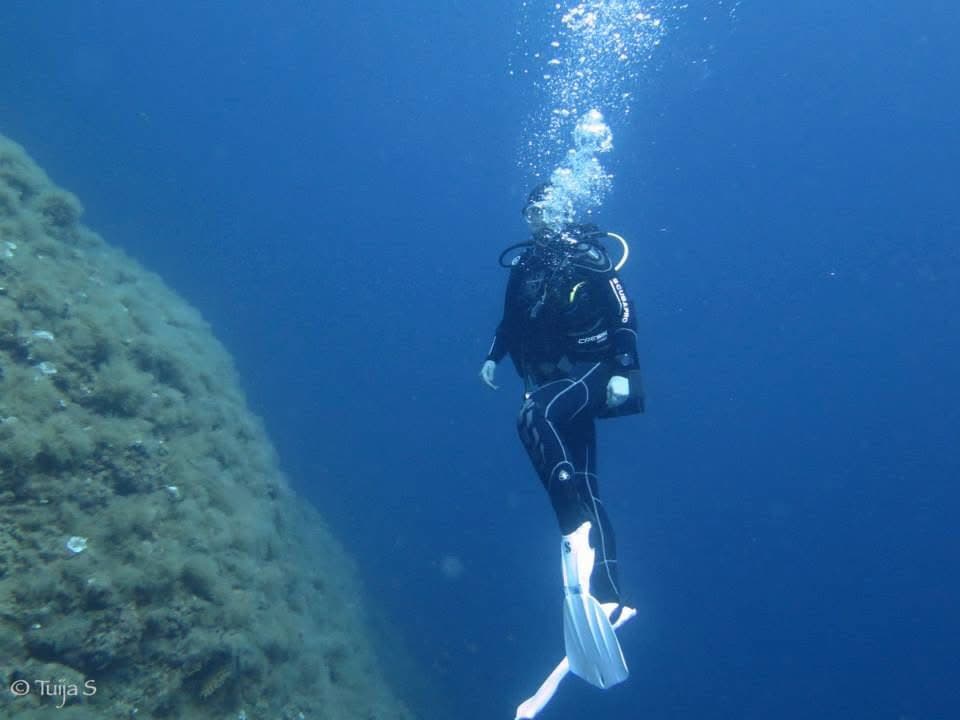 Diver ascending the vertical wall — bubbles rising into the blue-green Ligurian water, wall dropping beyond sport diving depth
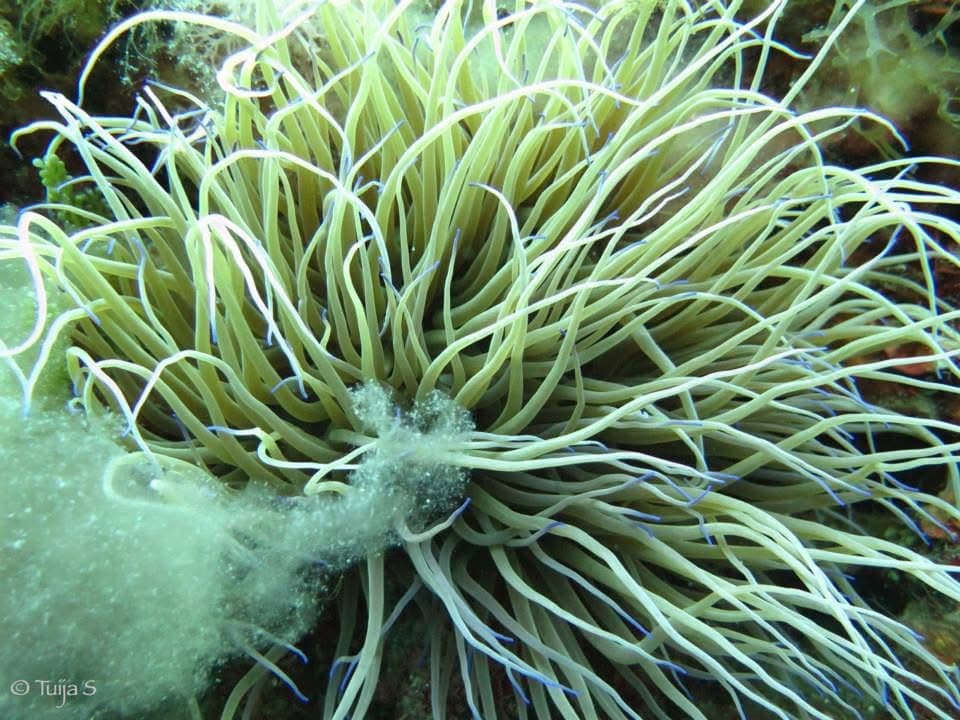 Snakelocks anemone (Anemonia sulcata) on the Portofino reef — blue-tipped tentacles characteristic; found on every sheltered wall inside the MPA
Europe's seas have been underestimated by divers who've only used them as a training ground before going somewhere tropical. Portofino as a destination in its own right — with the abbey, the village, the train along the Ligurian coast — offers something the tropical destinations don't.
Italy in Pictures
Il Cristo degli Abissi silhouetted from below — diver bubbles rising past the outstretched arms toward the surface at 17 metres
Il Cristo degli Abissi from the front — anemones on the hands, small wrasse working the folds of the robe, and a grouper stationed at the base of the plinth
San Fruttuoso abbey seen from the water on the approach by ferry — no road reaches the village; the sea is the only way in
Mediterranean sea bream moving along the algae-covered wall at Secca dell'Isola — fish density noticeably higher inside the protected boundary
Diver ascending the vertical wall — bubbles rising into the blue-green Ligurian water, wall dropping beyond sport diving depth
Snakelocks anemone (Anemonia sulcata) on the Portofino reef — the blue-tipped tentacles are characteristic; found on every sheltered wall inside the MPA