Curaçao
Curaçao — Dutch Caribbean, Coral Walls, and Willemstad
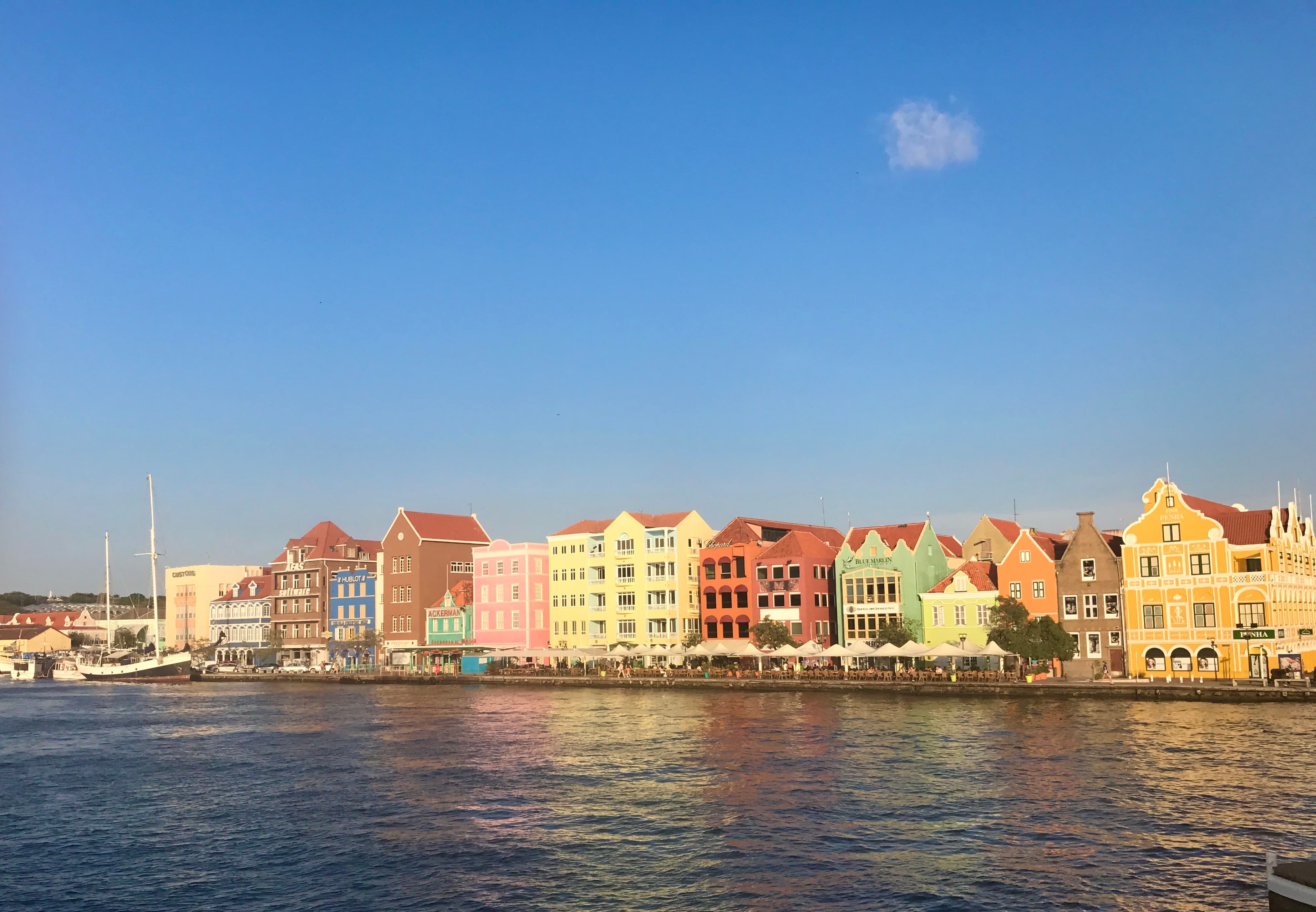
Curaçao sits at the southern edge of the Caribbean, outside the hurricane belt and close enough to the equator that the water is warm year-round. The walls start shallow and drop into blue nothing — Willemstad's pastel-coloured waterfront is one of the most visually distinctive cities in the Dutch Caribbean, and the turtles treat the reef like a commute.
The ABC islands and why Curaçao
Curaçao is the largest of the ABC islands — Aruba, Bonaire, Curaçao — a chain of Dutch Caribbean territories sitting just above the Venezuelan coast, reliably outside the hurricane belt. Bonaire has the reputation for shore diving; Curaçao has the reefs and fewer divers on them. The island's southwest coast runs for sixty kilometres with a near-continuous fringing reef accessible from shore, most of it underdived.
Willemstad — the pastel-coloured Dutch colonial capital — is the natural base: one of the more visually distinctive cities in the Caribbean, and close enough to the southwest coast that the westernmost sites are forty minutes away.
Shore diving the southwest coast
The logistics of Curaçao diving are simple: park at the entry point, walk in, descend the reef slope, follow the wall, ascend, walk out. No boat, no schedule, no twelve-diver group. The southwest coast has designated shore entry points with steps cut into the ironshore limestone, and the reef starts in two to three metres. By ten metres you are on the wall.
The walls here drop to beyond two hundred metres — deep enough that the bottom is not visible on any recreational dive. The upper sections carry good hard coral coverage, dense with sea fans, sponge formations in electric orange and purple, and the steady background motion of Caribbean reef fish. Visibility runs to twenty-five metres on calm days, occasionally more.
The turtles
The green turtles on the southwest reef have been undisturbed long enough that they simply do not treat divers as a threat. They feed, rest, and navigate around the reef with the unhurried indifference of animals who have worked out that the large mammals with tanks are no particular concern.
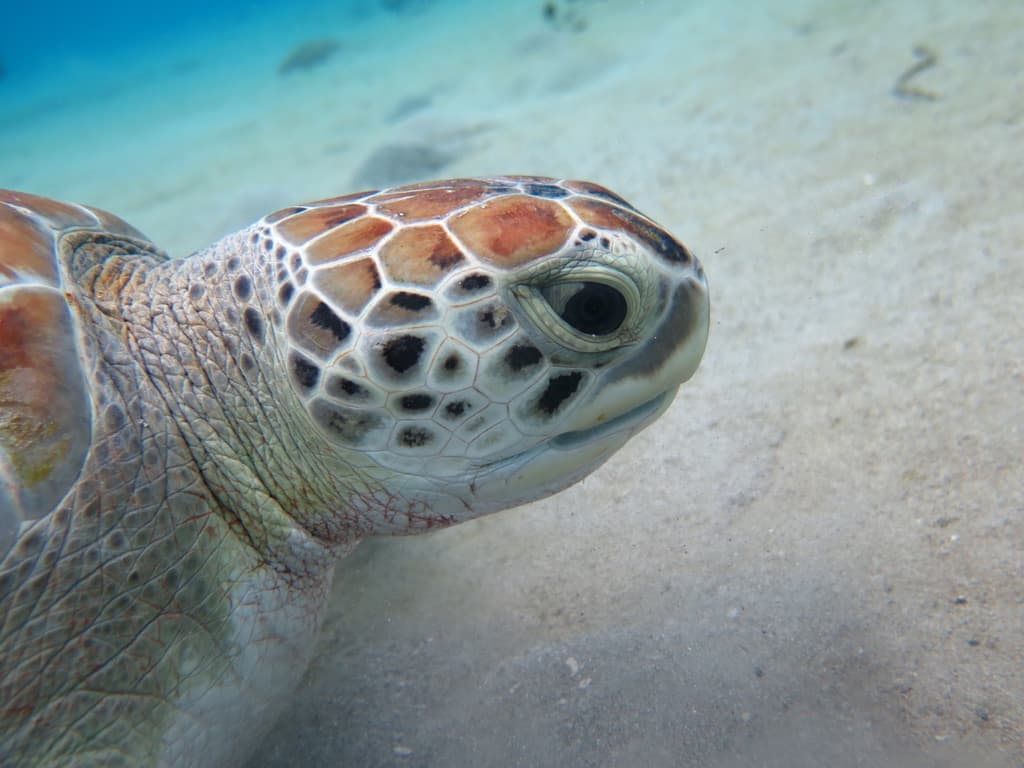 Green turtle portrait — at close range on the Porto Mari reef, entirely indifferent to the camera
On the Porto Mari reef a green turtle feeds on the sand flat at six metres — working methodically across the bottom, exhaling small clouds of sediment as it excavates seagrass rhizomes from the sand. It is aware of divers and continues feeding. Stay still and it can be watched for twenty minutes or more, moving perhaps four metres in that time.
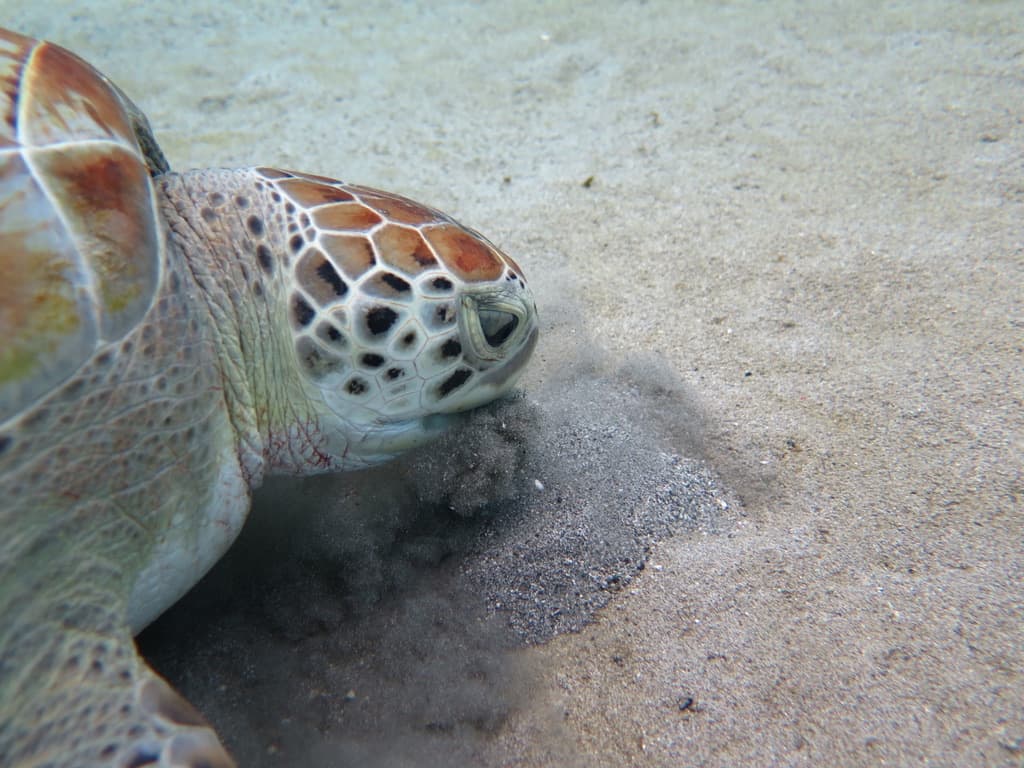 Green turtle feeding — excavating the sandy bottom at Caracasbaai, sediment cloud visible
Hawksbill turtles are less common but present — identifiable by the narrow, pointed beak and the overlapping scutes on the carapace. Both species concentrate in the five-to-ten metre zone on the upper reef.
Mushroom Forest
The Mushroom Forest is a formation of large pillar coral heads — some exceeding a metre in diameter — whose bases have been eroded by current and biological activity until they resemble oversized mushrooms balanced on narrow stems. The formation sits in eight to fifteen metres on the leeward side of a bay near Willemstad and is dense enough that navigating through it requires attention.
It is one of the more architecturally unusual reef structures in the Caribbean, and because the site is sheltered and shallow, the fish density is high — grunts, snappers, and small barracuda school in the spaces between the coral stems.
Blue Room
The Blue Room is a partially submerged sea cave on the northwest coast near Westpunt, accessible only by boat or by swimming around a headland. The cave floods with blue refracted light through an underwater entrance, creating the kind of light quality that exists almost nowhere else in nature. The dive itself is brief — ten minutes inside the cave at five metres — but the light conditions are genuinely unusual.
The entrance requires a short duck-under at the surface and the cave widens immediately inside. At midday the light is at its best. The cave holds no particular marine life but the experience of floating in that quality of light, in silence, is its own justification.
Willemstad above water
Willemstad's Handelskade waterfront — a row of Dutch colonial buildings in ochre, terracotta, and pale yellow, reflected in the Sint Annabaai — is the most photographed view in the Dutch Caribbean. The old city is a UNESCO World Heritage Site and the architecture is well-preserved. The Queen Emma Bridge, a pontoon bridge that swings open for maritime traffic, connects the two halves of the old city.
It is an unusual destination for a dive trip — a genuinely interesting city to return to at the end of a dive day, which is not something that can be said for most Caribbean dive bases.
Curaçao in Pictures
Willemstad's Handelskade waterfront — Dutch colonial buildings in ochre, terracotta, and pale yellow reflected in the Sint Annabaai
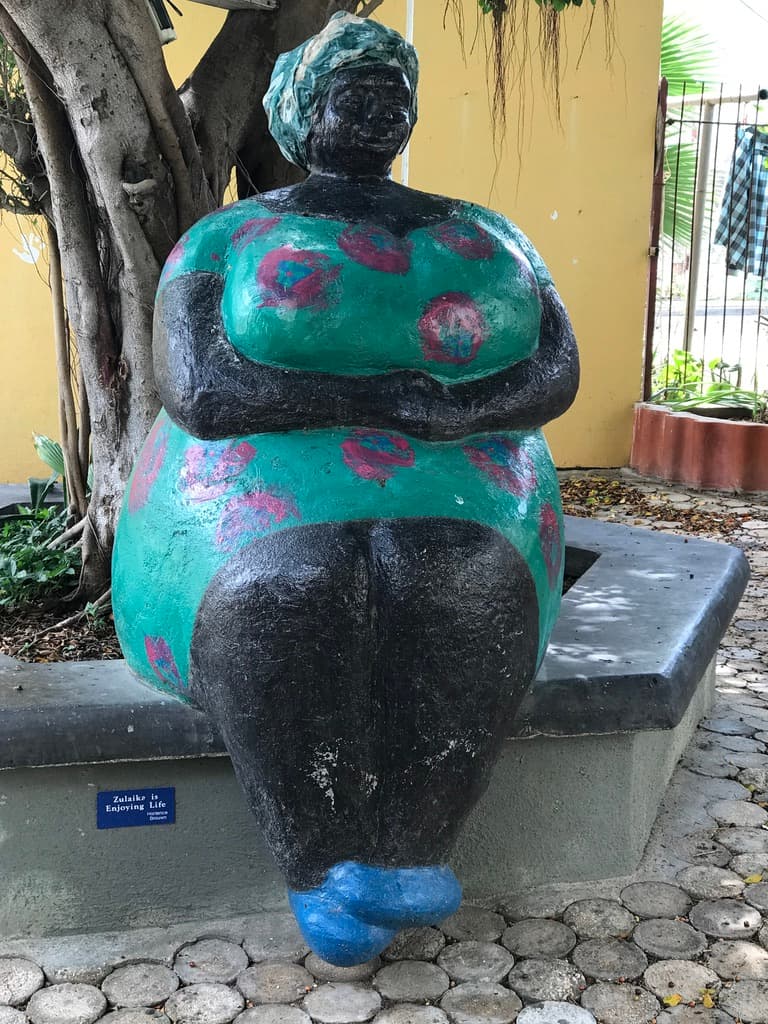
Zulaika is Enjoying Life — a painted sculpture in Willemstad's old city, the kind of detail that makes Curaçao above water as interesting as below