Tanzania
Tanzania — Zanzibar, the Serengeti, and the Indian Ocean
Tanzania sits at the junction of two extraordinary natural systems — the East African savannah inland, and the western Indian Ocean coastline. Zanzibar's Mnemba Atoll holds some of the healthiest coral in the region; Mafia Island is one of the largest whale shark aggregation sites in the world; and the mainland offers the Serengeti within a two-hour flight.
The geography
Tanzania is East Africa's largest country, bordered by Kenya and Uganda to the north, Rwanda and Burundi to the west, and Mozambique and Malawi to the south. Its interior holds the Serengeti, Ngorongoro Crater, and Kilimanjaro. Its 1,424-kilometre coastline faces the Indian Ocean and includes three major island systems — Zanzibar, Pemba, and Mafia — each with distinct marine environments.
The Indian Ocean off Tanzania is part of the Western Indian Ocean biodiversity hotspot, a region that contains more species of marine life per square kilometre than any other non-coral-triangle ocean area on earth. The reef systems here are old, structurally intact in the protected zones, and subjected to less diving pressure than equivalent sites in Southeast Asia or the Red Sea.
Zanzibar and Stone Town
Zanzibar — formally Unguja — is the main island, 85 kilometres long and 39 kilometres wide, lying 35 kilometres off the Tanzanian mainland. Stone Town, its historic capital and a UNESCO World Heritage Site, is a medieval Swahili trading port built on Arabic, Indian, Persian, and Portuguese influences over eight centuries of Indian Ocean trade. The carved wooden doors of the old city — hundreds of them, each different, each a status marker for the merchant family that commissioned it — are the most tangible expression of this layered history.
The island above water is a study in contrasts: the dense urban fabric of Stone Town and the simple beach settlements of the north and east coast; clove plantations (Zanzibar was once the world's largest clove producer) and the fishing villages where the boats go out before dawn; the Blue Lagoon tour boats and the local dhow captains fixing nets beside them.
Mnemba Atoll
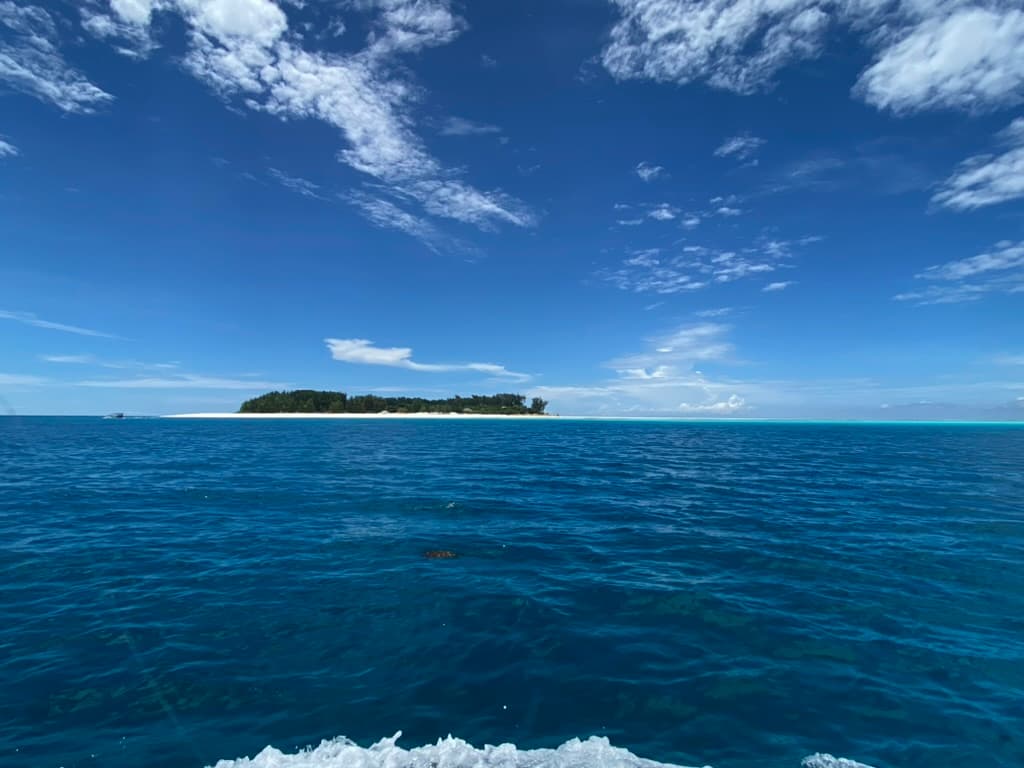
Mnemba Atoll sits 3 kilometres off Zanzibar's northeast tip, a no-take marine protected area encircling a tiny private island. The protection is real — fishing boats are excluded, and the reef shows it. Hawksbill turtles commute between coral heads with the confidence of animals that have never been harassed. Humphead parrotfish graze in groups of 30 on the reef flat. Spinner dolphins use the atoll as a day-resting site during the calm months.
The diving is not technically demanding — depths of 5 to 25 metres, manageable current, clear water. The draw is density: fish life representative of a healthy Indian Ocean reef system, encountered in concentrations that are increasingly rare on accessible dive sites globally.
Mafia Island
Mafia Island, 160 kilometres south of Zanzibar, is less visited and more ecologically significant. The Mafia Island Marine Park — one of the largest in the Indian Ocean — includes Chole Bay, mangrove systems, and the offshore reef structures that attract one of the highest densities of whale sharks in the western Indian Ocean.
Whale sharks aggregate off Mafia's south coast between October and February, drawn by spawning fish aggregations. Snorkelling with 30 or more individuals in 3 to 8 metres of water — some exceeding 8 metres in length — is the most concentrated whale shark encounter available in Africa. The interaction protocols here are strictly enforced: no touching, no blocking, minimum distances observed from boats. The sharks are habituated to snorkellers but not acclimatised to crowding.
The reef diving at Mafia is less visited than Zanzibar and correspondingly less impacted. Chole Bay has manta cleaning stations between October and April; the outer reef walls at Kinasi Pass and Forbes Bank hold good pelagic life and large grouper.
The mainland and safari combination
The Tanzanian mainland offers one of the most logical combinations in adventure travel: Indian Ocean diving and East African safari within a two-hour domestic flight. Dar es Salaam connects to Kilimanjaro, Arusha (for the Serengeti), and the southern parks. A ten-day itinerary divides naturally — five days diving Zanzibar or Mafia, flight to Arusha, four days in the Serengeti or Ngorongoro.
The Serengeti's great migration — 1.5 million wildebeest and 250,000 zebra moving between Tanzania and Kenya in a year-round cycle — peaks in different locations depending on the month. The calving season (February to March) on the southern Serengeti plains is the most wildlife-dense phase; the river crossings at the Mara River (July to September) are the most dramatic. Both are within range of a Tanzania dive trip at the right time of year.
Pemba
Pemba, north of Zanzibar and less frequently visited, has a reputation among technical divers for the Pemba Channel — a deep oceanic channel between the island and the mainland that concentrates current and pelagic life. The walls here drop to over 1,000 metres, with healthy hard and soft coral structure above 30 metres and occasional schooling hammerheads reported in the channel. The island's infrastructure for diving is limited, which serves as its own filter.
Seasons
The southeast monsoon (Kusi, June to October) brings the best diving conditions — calmer seas, higher visibility, and lower water temperatures (25–26°C) — on the west coast of Zanzibar and around Mafia. The northwest monsoon (Kaskazi, November to March) reverses the pattern and can affect east-facing sites. Whale sharks at Mafia peak October to February. Humpback whales pass through the channel between August and September.
Tanzania in Pictures
Zanzibar's north coast — the island sits 35 kilometres off the Tanzanian mainland in the Indian Ocean