Micronesia
Micronesia — Blue Corner, Truk Lagoon, and the Mantas of Yap
Micronesia spans four million square kilometres of the western Pacific — a scattering of islands and atolls that between them holds the most dramatic drift dive on earth, the largest concentration of accessible WWII wrecks, and a manta ray aggregation that has been running on the same schedule since before anyone started counting.
The geography
Micronesia occupies the northwestern Pacific between Hawaii and the Philippines — a vast ocean territory containing two distinct political entities: the Federated States of Micronesia (Yap, Chuuk, Pohnpei, Kosrae) and the Republic of Palau, which sits to the southwest. The islands are a mix of high volcanic peaks and low coral atolls, surrounded by some of the most nutrient-rich and biologically productive water in the Pacific. The diving is divided between three world-class destinations that happen to specialise in entirely different things: Palau for pelagic and drift, Yap for manta rays, and Chuuk for wrecks.
Getting there typically means routing through Guam or Manila, with onward connections to each island group. Palau receives its own direct flights from several Asian hubs.
Palau
Palau is a compact archipelago of around 340 islands and atolls, most within the Palau National Marine Sanctuary — one of the largest fully protected marine areas in the world. The diving is concentrated around the Rock Islands, a collection of limestone formations rising from shallow lagoons, and the barrier reef systems to the southwest.
Blue Corner is the site that defines Palau's reputation — a submerged shelf at 12–28 metres where two current systems converge and push nutrient-rich water up against the reef edge. The result is a concentration of marine life that functions like a compressed ecosystem: grey reef sharks holding position in the surge, Napoleon wrasse moving in loose circuits, enormous schools of trevally and snapper, turtles resting on the coral. The drift, when the current runs properly, requires a reef hook to hold position — and the protocol is to hook in, neutralise your buoyancy, and watch. The scene shifts constantly.
Blue Hole is a series of caverns descending from 8 metres to beyond 40, opening onto a wall where grey reef sharks cruise the blue water below. The light from the surface penetrates in columns through the ceiling openings. German Channel is the route through Palau's barrier reef used by mantas to reach their cleaning station — oceanic mantas the size of dining tables arriving reliably from the passage side.
Jellyfish Lake, accessible only to Palau permit holders, is an inland marine lake where millions of golden jellyfish (Mastigias papua etpisoni) have lost their sting through millions of years of isolated evolution. Snorkelling through a dense aggregation of jellyfish that don't sting is one of the stranger experiences in Pacific diving.
Yap
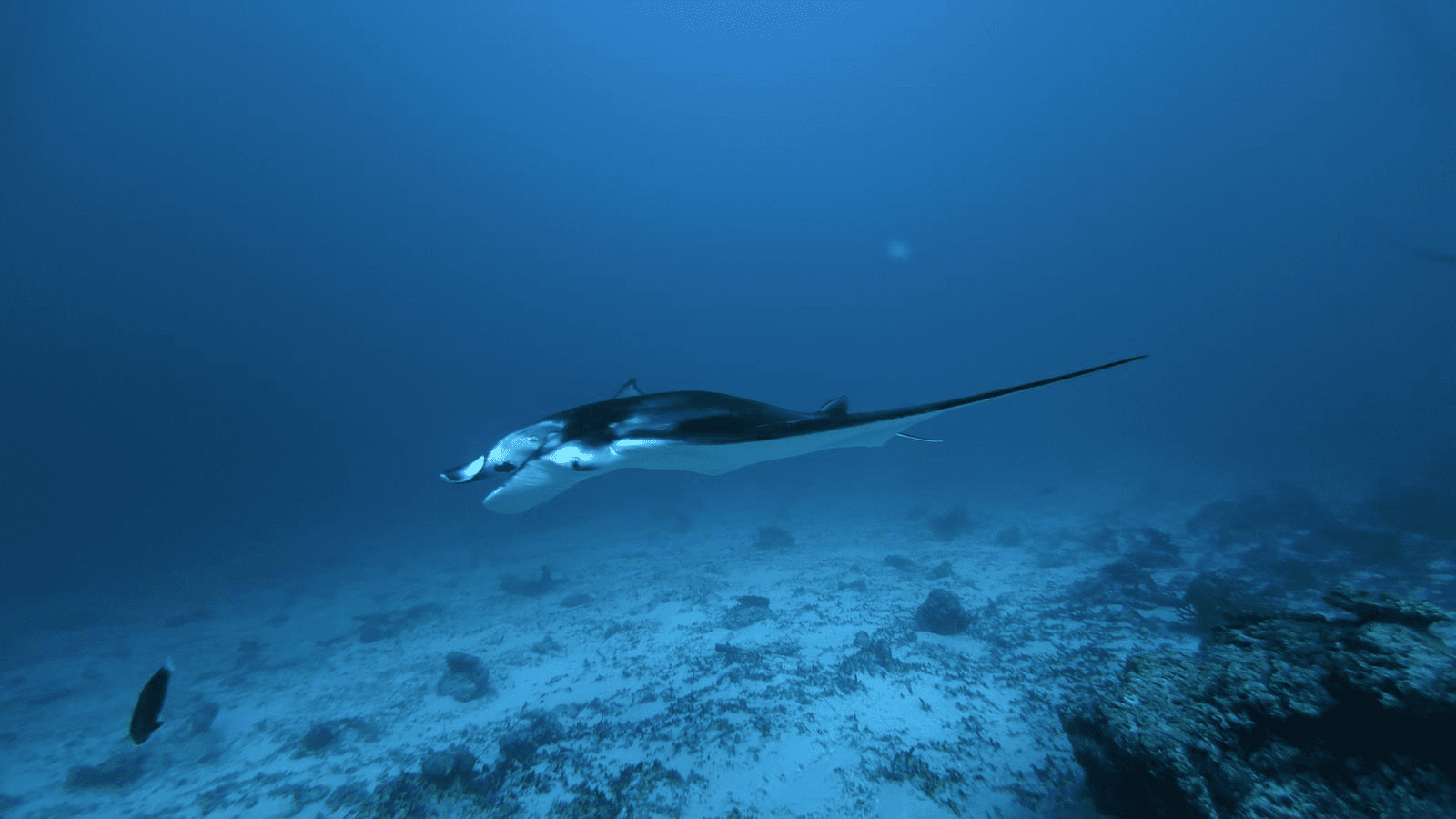
Yap is a slow, unhurried island group in the western Federated States, with no mass tourism infrastructure and a diving culture built around a single dominant attraction. Mi'l Channel is a cleaning station for oceanic manta rays (Mobula birostris) — individuals returning daily to the same cleaning heads where wrasse remove parasites from gill plates and skin. The station has been observed for decades, and individual mantas have been identified by ID photos and tracked across years. Resident populations of 20–30 individuals occupy the channel year-round; migratory individuals pass through with seasonal currents.
The mantas at Yap are not an encounter in the sense of a chance sighting — the cleaning station functions on a schedule, and the protocol is to settle onto the sand at the base of the coral heads and wait. The mantas arrive on their own terms, hover above the cleaners, and ignore the divers entirely. Dive durations at the station are limited to minimise disturbance; multiple dives per day at different tidal phases are standard.
Beyond Mi'l Channel, Yap has wall diving along the outer reef, a population of mandarin fish at a specific site near Manta Ridge (best at dusk), and an intact traditional culture — stone money, men's houses, the village structure — that makes the surface experience as distinctive as the diving.
Chuuk (Truk) Lagoon
Chuuk Lagoon is a WWII wreck diving destination unlike anything else on earth. In February 1944, Operation Hailstone — a two-day American air attack on the Imperial Japanese Navy's forward base — sank over 60 vessels in the lagoon: warships, supply freighters, tankers, submarines, and aircraft. Most of the hulls remain, heavily encrusted and at recreational diving depths of 12–60 metres. The cargo of the supply ships in particular is extraordinarily intact: aircraft parts, torpedoes, ammunition, gas masks, personal effects, and medical supplies still in position in the holds.
The Fujikawa Maru (18–33 m) holds Zero fighters in the forward hold. The Sankisan Maru carries bulldozers, trucks, and ammunition. The Shinkoku Maru has the most intact medical bay of any wreck site in the world. The Heian Maru is the largest accessible wreck, with multiple submarine torpedoes in the hold. None of these sites have been significantly disturbed — the remoteness of the lagoon, the depth, and the protection status have preserved them in a state that wreck divers elsewhere in the world can only compare against.
Diving Chuuk is principally done by liveaboard out of Weno, the main island. The sites are spread across the lagoon and require navigation between marked mooring buoys. Penetration diving at depth with zero visibility in silt-stirred conditions requires overhead environment certification and experience; the most significant interiors are accessible only to properly qualified and equipped divers.
Pohnpei and Kosrae
The eastern states of the FSM — Pohnpei and Kosrae — receive a fraction of the visitors of Palau, Yap, and Chuuk, and offer quieter, less-trafficked reef diving with excellent water clarity and more relaxed marine life. Pohnpei is better known above water for Nan Madol, a megalithic city of artificial islets built on a tidal flat from basalt columns — one of the most significant archaeological sites in the Pacific. Kosrae, the easternmost state, has some of the healthiest and least-visited fringing reef in Micronesia.
Seasons
The diving season runs November through May, when northeast trade winds keep the ocean settled. June through October brings the southwest swell, which affects exposed sites in Palau and Yap more than the sheltered lagoon at Chuuk. Water temperatures sit at 27–30°C year-round. Manta rays at Yap are present throughout the year; hammerhead schools at Palau's German Channel are most reliable in October through December. The Truk lagoon is diveable year-round.